
TEAS Science Practice Questions With Answers: 25 Free ATI TEAS 7 Questions
These 25 free TEAS science practice questions follow the ATI TEAS 7 blueprint, with answers and explanations for every question. They cover the four Science sub-sections in roughly the same proportions as the real exam: Human Anatomy and Physiology, Biology, Chemistry, and Scientific Reasoning.
Work through each question before reading the answer. If you want to simulate test conditions, give yourself about 30 minutes for all 25 questions; the real section allows 60 minutes for 50 questions.
Key takeaways
- TEAS 7 Science has 50 questions in 60 minutes: 44 scored and 6 unscored pretest items.
- Human Anatomy and Physiology is the biggest content area, with 18 scored questions.
- You have about 72 seconds per question, so speed matters as much as recall.
- Scientific reasoning questions test how you think, not what you've memorized, and they reward careful reading.
What's on the TEAS 7 Science section?
The Science section has 50 questions and a 60-minute time limit, or about 72 seconds per question:
- Human Anatomy and Physiology: 18 questions
- Biology: 9 questions
- Chemistry: 8 questions
- Scientific Reasoning: 9 questions
- Unscored pretest items: 6 questions
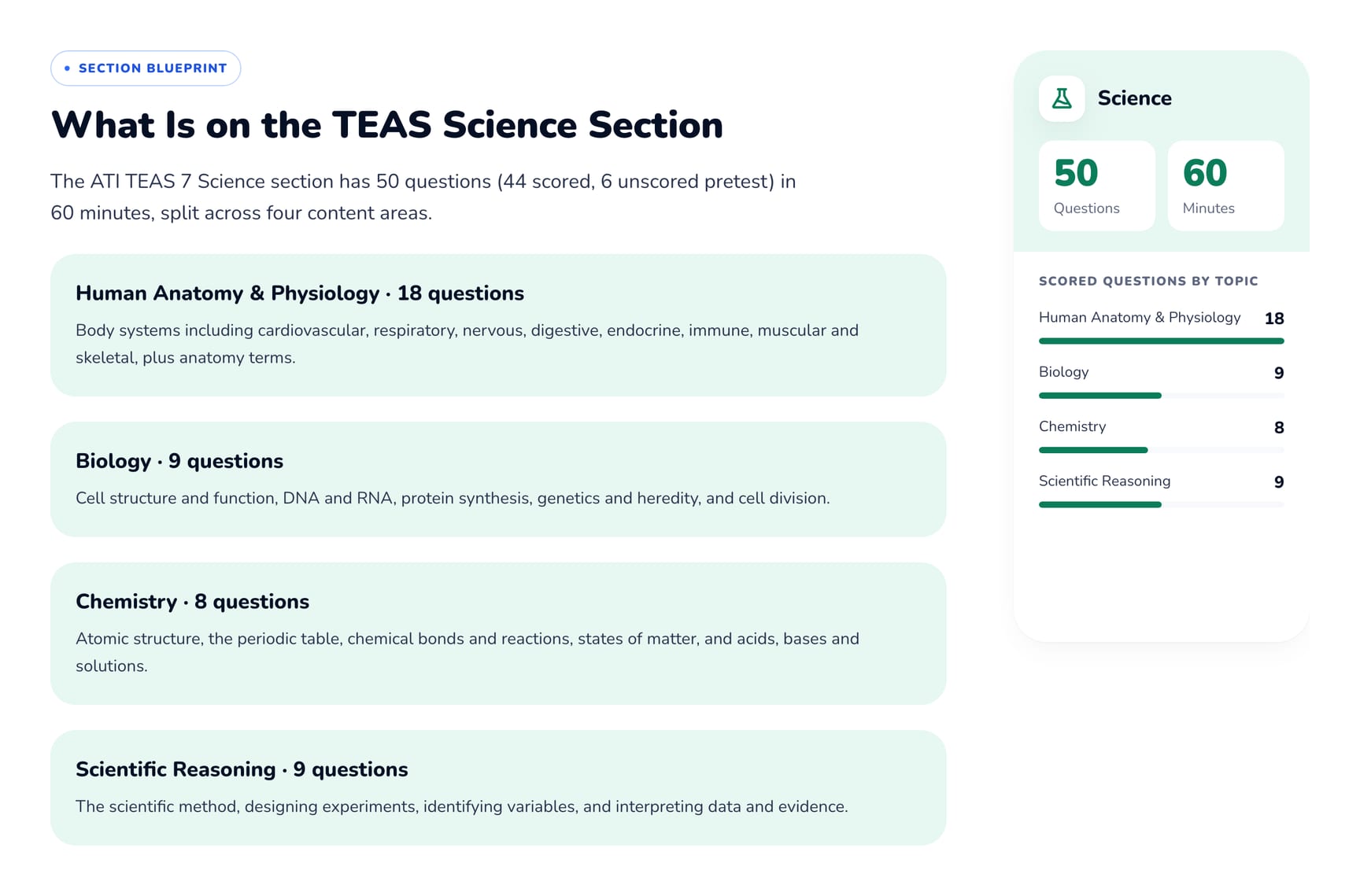
The TEAS 7 Science blueprint, from our TEAS science practice page.
Anatomy and physiology carries the most weight, so it gets the most questions below.
Human anatomy and physiology questions
Question 1
Which chamber of the heart pumps oxygenated blood into the aorta?
A. Right atrium
B. Right ventricle
C. Left atrium
D. Left ventricle
Answer: D. Left ventricle. Oxygenated blood returns from the lungs to the left atrium, passes to the left ventricle, and is pumped into the aorta for delivery to the body. The right ventricle pumps deoxygenated blood to the lungs.
Question 2
Where does most nutrient absorption take place?
A. Stomach
B. Small intestine
C. Large intestine
D. Esophagus
Answer: B. Small intestine. Villi and microvilli give the small intestine an enormous surface area for absorption. The large intestine mainly absorbs water and electrolytes.
Question 3
What is the functional unit of the kidney?
A. Nephron
B. Ureter
C. Renal pelvis
D. Urethra
Answer: A. Nephron. Each kidney contains about a million nephrons, which filter blood and form urine. The glomerulus is one part of the nephron.
Question 4
In which structures does gas exchange occur in the lungs?
A. Bronchi
B. Trachea
C. Alveoli
D. Pleura
Answer: C. Alveoli. Oxygen and carbon dioxide diffuse across the thin walls of the alveoli and the surrounding capillaries.
Question 5
Which hormone lowers blood glucose levels?
A. Glucagon
B. Insulin
C. Cortisol
D. Epinephrine
Answer: B. Insulin. Insulin, released by the beta cells of the pancreas, helps cells take up glucose. Glucagon, cortisol, and epinephrine all raise blood glucose.
Question 6
Which type of muscle tissue is involuntary and lines the walls of blood vessels and the digestive tract?
A. Skeletal muscle
B. Cardiac muscle
C. Smooth muscle
D. Voluntary striated muscle
Answer: C. Smooth muscle. Smooth muscle is non-striated and involuntary. Cardiac muscle is also involuntary but is found only in the heart.
Question 7
Using directional terms, the knee is ______ to the ankle.
A. Distal
B. Proximal
C. Medial
D. Lateral
Answer: B. Proximal. Proximal means closer to the point where a limb attaches to the trunk. The knee is closer to the hip than the ankle is.
Question 8
Which blood cells are primarily responsible for fighting infection?
A. Erythrocytes
B. Leukocytes
C. Platelets
D. Hemoglobin
Answer: B. Leukocytes. White blood cells (leukocytes) defend against pathogens. Erythrocytes carry oxygen, and platelets help with clotting.
Question 9
Which division of the nervous system triggers the "fight or flight" response?
A. Parasympathetic
B. Sympathetic
C. Somatic
D. Enteric
Answer: B. Sympathetic. The sympathetic nervous system raises heart rate, dilates the airways, and redirects blood to the muscles. The parasympathetic system does the opposite ("rest and digest").
Question 10
Which bone is located in the upper arm?
A. Radius
B. Ulna
C. Humerus
D. Femur
Answer: C. Humerus. The radius and ulna are in the forearm, and the femur is in the thigh.
Question 11
Which gland is often called the "master gland" because it regulates many other endocrine glands?
A. Thyroid
B. Adrenal
C. Pituitary
D. Pancreas
Answer: C. Pituitary. The pituitary releases hormones that control the thyroid, adrenal glands, and gonads. It is itself regulated by the hypothalamus.
Question 12
Ligaments connect:
A. Muscle to bone
B. Bone to bone
C. Muscle to muscle
D. Skin to muscle
Answer: B. Bone to bone. Ligaments stabilize joints by connecting bones. Tendons connect muscle to bone.
Biology questions
Question 13
Which organelle produces most of a cell's ATP?
A. Nucleus
B. Ribosome
C. Mitochondrion
D. Golgi apparatus
Answer: C. Mitochondrion. Mitochondria carry out aerobic cellular respiration, which produces most of the cell's ATP.
Question 14
In DNA, adenine pairs with which base?
A. Guanine
B. Cytosine
C. Thymine
D. Uracil
Answer: C. Thymine. In DNA, adenine pairs with thymine and guanine pairs with cytosine. Uracil replaces thymine in RNA.
Question 15
What is the result of mitosis?
A. Four genetically different haploid cells
B. Two genetically identical diploid cells
C. Two genetically different haploid cells
D. Four genetically identical diploid cells
Answer: B. Two genetically identical diploid cells. Mitosis is used for growth and repair. Meiosis produces four genetically different haploid gametes.
Question 16
Two parents are both heterozygous (Bb) for a trait. What is the probability that their child will be homozygous recessive (bb)?
A. 0%
B. 25%
C. 50%
D. 75%
Answer: B. 25%. A Punnett square for Bb × Bb gives BB, Bb, Bb, and bb. One of the four outcomes is bb.
Question 17
Enzymes are made of which type of macromolecule?
A. Carbohydrates
B. Lipids
C. Proteins
D. Nucleic acids
Answer: C. Proteins. Enzymes are proteins that speed up chemical reactions by lowering activation energy.
Chemistry questions
Question 18
A solution has a pH of 3. How is this solution best described?
A. Strongly basic
B. Neutral
C. Acidic
D. Slightly basic
Answer: C. Acidic. A pH below 7 is acidic, 7 is neutral, and above 7 is basic.
Question 19
Which subatomic particle carries a negative charge?
A. Proton
B. Neutron
C. Electron
D. Nucleus
Answer: C. Electron. Protons are positive and neutrons are neutral. Both are found in the nucleus.
Question 20
When the equation H2 + O2 → H2O is balanced, what coefficient goes in front of H2O?
A. 1
B. 2
C. 3
D. 4
Answer: B. 2. The balanced equation is 2H2 + O2 → 2H2O, which gives four hydrogen atoms and two oxygen atoms on each side.
Question 21
A covalent bond forms when two atoms:
A. Transfer electrons
B. Share electrons
C. Share protons
D. Exchange neutrons
Answer: B. Share electrons. Covalent bonds involve shared electron pairs. Ionic bonds form when electrons are transferred from one atom to another.
Scientific reasoning questions
Question 22
A student tests how the amount of fertilizer affects plant height. What is the independent variable?
A. Plant height
B. Amount of fertilizer
C. Type of plant
D. Amount of sunlight
Answer: B. Amount of fertilizer. The independent variable is the one the researcher changes. Plant height is the dependent variable; plant type and sunlight should be kept constant.
Question 23
How many grams are in 2.5 kilograms?
A. 25 g
B. 250 g
C. 2,500 g
D. 25,000 g
Answer: C. 2,500 g. One kilogram equals 1,000 grams, so 2.5 × 1,000 = 2,500 grams.
Question 24
Which of the following is a testable hypothesis?
A. Plants are more beautiful in sunlight.
B. If plants receive more sunlight, then they will grow taller.
C. Sunlight is important for life.
D. Some plants prefer the shade.
Answer: B. A testable hypothesis predicts a measurable relationship between variables. "More sunlight" and "taller" can both be measured.
Question 25
A student repeats a measurement five times and gets nearly identical results each time, but every result is far from the accepted value. The results are:
A. Accurate and precise
B. Accurate but not precise
C. Precise but not accurate
D. Neither accurate nor precise
Answer: C. Precise but not accurate. Precision means results agree with each other. Accuracy means results are close to the true value.
How did you do?
- 22–25 correct: strong. Keep practicing under timed conditions.
- 17–21 correct: solid, with some gaps. Review the explanations for every miss.
- 16 or fewer: focus on anatomy and physiology first, since it carries the most questions.
Write down which sub-section each missed question came from. A pattern of misses in one area, such as the endocrine system or balancing equations, tells you exactly what to study next.
TEAS Science topic checklist
Use this checklist to find gaps before test day. If you can't explain a topic out loud in two or three sentences, mark it for review.
Human anatomy and physiology
- Directional terms, body planes, and body cavities
- Cardiovascular system: blood flow through the heart, vessels, and blood components
- Respiratory system: airways, alveoli, and gas exchange
- Nervous system: central vs. peripheral, sympathetic vs. parasympathetic, neurons
- Digestive system: organs, enzymes, and where absorption happens
- Endocrine system: major glands and the hormones they release
- Urinary system: kidney structure, the nephron, and fluid balance
- Immune and lymphatic systems: white blood cells and how the body fights infection
- Musculoskeletal system: bones, muscle types, tendons, and ligaments
- Integumentary and reproductive systems: structure and basic function
Biology
- Cell structure and organelle functions
- DNA, RNA, and protein synthesis
- Mitosis and meiosis
- Mendelian genetics and Punnett squares
- Macromolecules: carbohydrates, lipids, proteins, and nucleic acids
Chemistry
- Atomic structure and the periodic table
- Ionic and covalent bonds
- Balancing chemical equations and types of reactions
- States of matter
- Acids, bases, pH, and solutions
Scientific reasoning
- The scientific method and testable hypotheses
- Independent, dependent, and controlled variables
- Reading graphs, tables, and experimental data
- Metric units and conversions
- Accuracy vs. precision, and drawing valid conclusions
A 2-week TEAS Science study plan
- Days 1–2: take a diagnostic and list your three weakest science sub-topics.
- Days 3–7: anatomy and physiology, one or two body systems per day. Finish each day with 10–15 practice questions on that system.
- Days 8–9: biology: cells, DNA and RNA, cell division, and genetics.
- Days 10–11: chemistry: atoms, bonds, balancing equations, and pH.
- Day 12: scientific reasoning: variables, hypotheses, and data interpretation.
- Days 13–14: two timed science sets of 50 questions in 60 minutes, then review every miss.
Common mistakes on TEAS Science
- Memorizing terms without functions. Questions often ask what a structure does or what happens when it fails.
- Mixing up look-alike terms, such as tendons and ligaments, mitosis and meiosis, or proximal and distal.
- Rushing scientific reasoning questions. The answer is usually in the experiment description; read it twice.
- Skipping chemistry. It's only 8 scored questions, but the basics (atoms, bonds, pH) are quick points.
Tips for the TEAS Science section
- Prioritize anatomy and physiology. With 18 scored questions, it's the biggest single source of points on the section.
- Learn body systems as connected processes, such as how the respiratory and cardiovascular systems work together, rather than as lists of terms.
- Know your directional terms and metric conversions cold. They're quick points that don't require recall of complex material.
- Read scientific reasoning questions carefully. Many hinge on identifying variables, controls, or the difference between precision and accuracy.
- Keep moving. At about 72 seconds per question, flag hard questions and come back to them.
Frequently asked questions
How many science questions are on the TEAS 7?
50 questions in 60 minutes: 18 anatomy and physiology, 9 biology, 8 chemistry, 9 scientific reasoning, and 6 unscored pretest items.
Is TEAS Science the hardest section?
For many students, yes. It covers four subjects, gives you about 72 seconds per question, and leans heavily on anatomy and physiology. It's also where focused study can raise your score quickly.
How long should I study for TEAS Science?
Most students need two to four weeks of focused science study, depending on how recently they took anatomy and physiology, biology, and chemistry. A diagnostic will tell you where to start.
What's the best way to study anatomy and physiology for the TEAS?
Study one body system at a time, focus on how structures work together, and finish each session with practice questions. Flashcards help with terms; practice questions help with application.
Keep practicing
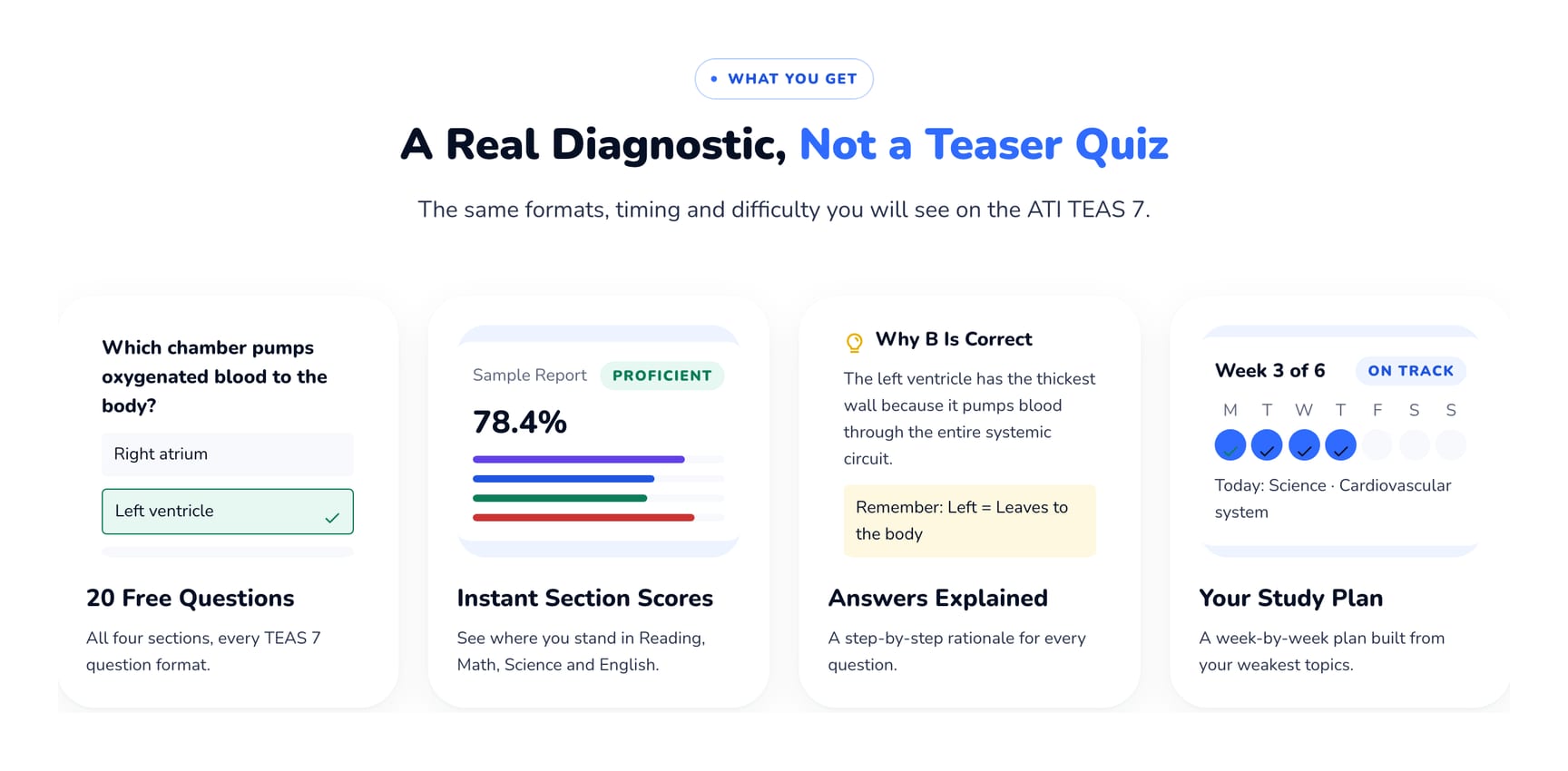
The free diagnostic includes science questions like the ones above, with an explanation for every answer.
These 25 questions are a starting point. Our TEAS science practice page covers every Science topic in more depth, and the free TEAS practice test gives you a scored baseline across all four sections. Wondering what score you need? Read what counts as a good TEAS score.
