
What Is a Good TEAS Score? Score Ranges, Averages & What Nursing Schools Want

A good TEAS score is one that clears your nursing program's minimum and puts you ahead of other applicants. Most programs set their minimum in ATI's Proficient range (58.7% and up), while competitive BSN programs often admit students scoring in the high 70s to 80s. Because every school sets its own cutoff, the most useful number is your target program's published minimum plus a cushion of 5–10 points.
This guide explains exactly how the ATI TEAS 7 is scored, what each score level means, what an average score looks like, and how to work out the score you need. It finishes with a practical plan for raising your score.
Key takeaways
- There is no universal passing score. Each nursing program sets its own minimum.
- Proficient (58.7%–79.3%) is the most common minimum; Advanced (80.0%–91.3%) is competitive almost everywhere.
- Only 150 of the 170 questions are scored, and there's no penalty for guessing, so answer every question.
- Science and Math are where most applicants lose points, so they're where most applicants can gain them fastest.
How the ATI TEAS 7 is scored
The TEAS 7 has 170 questions and a 209-minute time limit, but only 150 questions count toward your score. The other 20 are unscored pretest items that ATI is trialling for future exams. They look exactly like the rest, so you can't tell which ones they are.
After the exam you receive a score report with four layers of detail:
- An Adjusted Individual Total Score. This is the composite percentage schools look at first, and the number people mean when they talk about "my TEAS score."
- Four section scores for Reading, Math, Science, and English and Language Usage.
- Sub-scores for the content areas inside each section, such as Human Anatomy and Physiology or Measurement and Data.
- An Academic Preparedness Level, which places your composite score in one of five bands.
There is no penalty for wrong answers. A guess has a chance of earning a point; a blank never does. If time is running out, make sure every question has an answer.
TEAS 7 score levels (Academic Preparedness Levels)
ATI groups TEAS 7 composite scores into five Academic Preparedness Levels:
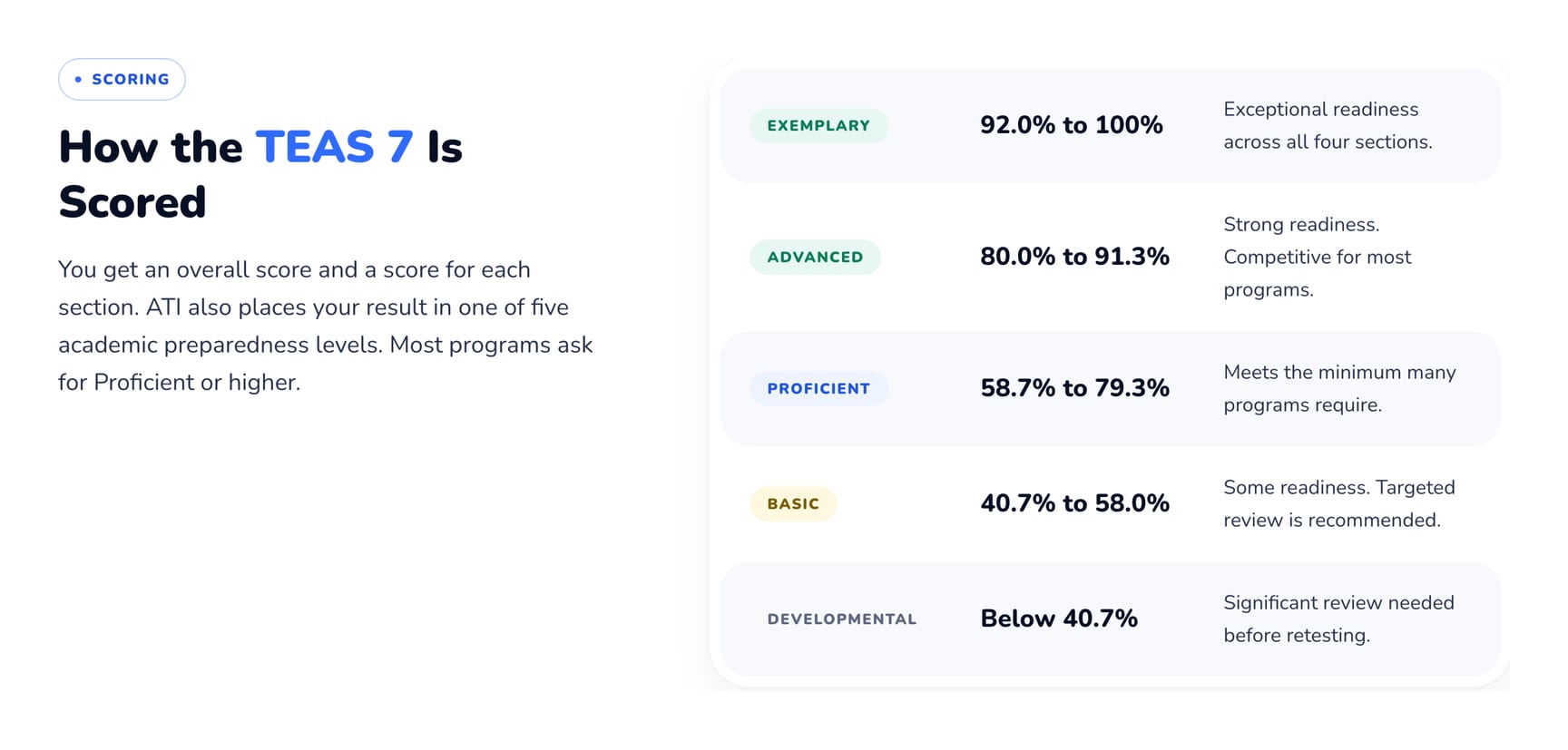
The five TEAS 7 score levels, from our TEAS 7 prep guide.
- Exemplary (92.0%–100%): exceptional readiness across all four sections.
- Advanced (80.0%–91.3%): strong readiness and competitive for most programs.
- Proficient (58.7%–79.3%): meets the minimum many programs require.
- Basic (40.7%–58.0%): some readiness, but most nursing programs will want a retake.
- Developmental (below 40.7%): significant review needed before retesting.
Always confirm the levels printed on your own score report, since that's the document your school will see.
What is the average TEAS score?
ATI doesn't publish a national average for every testing cohort, but prep companies and nursing educators commonly cite an average composite in the low 60s. That puts the typical test taker inside the Proficient band, but well below what competitive programs admit.
The average that matters more is the average among admitted students at your target school. Many programs publish it on their admissions page or share it at information sessions, and it's usually well above the national figure. If a program tells you its admitted students averaged 82%, a 68% may meet the minimum but is unlikely to win a seat.
So what TEAS score do you need?
Use these as planning targets, then check your specific programs:
- Program minimum only: often 58.7% (the start of Proficient) to around 65%. Meeting the minimum makes you eligible; it rarely makes you competitive.
- Typical ADN or community college program: aim for the high 60s to mid 70s.
- Competitive BSN or accelerated program: aim for 80% or higher, which is the Advanced range.
A practical rule: aim at least 5–10 points above your program's minimum. Seats are limited, and many schools rank applicants on a points system that combines TEAS score, GPA, and prerequisite grades. A few extra TEAS points can move you up that list.
Work out your personal target in three steps
- List every program you're applying to with its minimum composite score, any section minimums, and its admitted-student average if published.
- Take the highest number on that list as your baseline. If you only meet the lowest program's minimum, you limit your options.
- Add 5 points as a safety margin for test-day nerves and time pressure. That's your target score.
Don't ignore section minimums
Some programs also set minimums for individual sections, most often Science and Reading. A strong composite won't help if your Science score falls below the program's cutoff. Check whether each school lists section requirements, and treat them as separate targets.
Which sections pull scores down the most?
Science is the section most applicants find hardest. It has 50 questions in 60 minutes, and Human Anatomy and Physiology alone accounts for 18 of the scored questions. Math is the second most common weak spot, mainly because of time pressure: 38 questions in 57 minutes.
If you want to raise your composite quickly, start with the section where your score is lowest and the question count is highest. For most students that means anatomy and physiology first, then math. Our 25 free TEAS science practice questions are a quick way to see where you stand in science.
How to raise your TEAS score
- Take a diagnostic first. A baseline shows which sections and sub-topics cost you the most points, so you don't waste time re-studying what you already know.
- Study by sub-topic, not by section. "Science" is too broad to act on; "the cardiovascular and respiratory systems" is a study plan.
- Review every explanation, including questions you got right by guessing. Lucky guesses hide real gaps.
- Practice under real timing. English allows about one minute per question and Science about 72 seconds, so pacing matters as much as knowledge.
- Finish with full-length practice exams in the final two weeks to build stamina for a 209-minute test.
Our free diagnostic gives you instant section scores, an explanation for every answer, and a study plan built around your weakest topics:
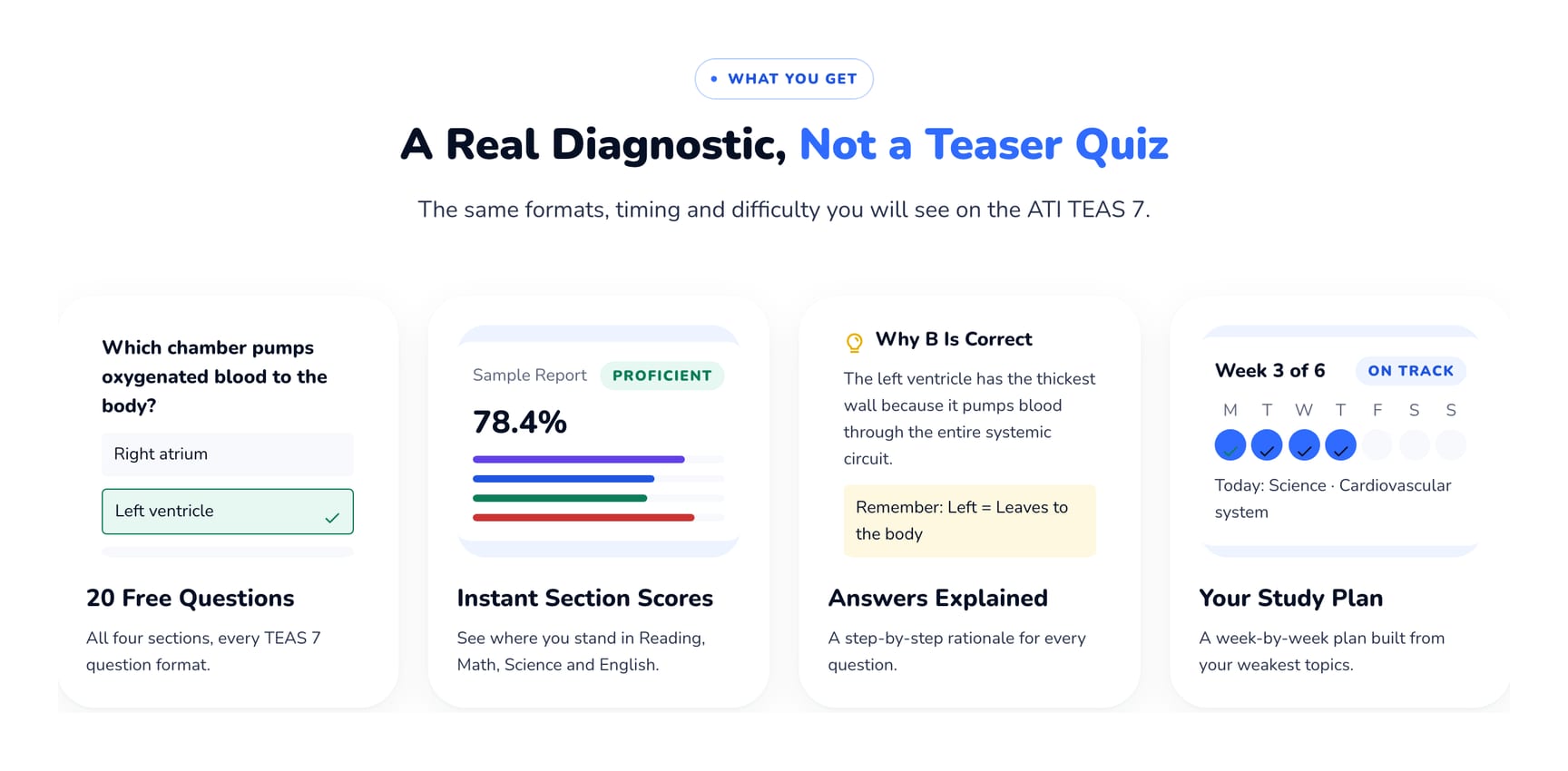
What you get with the free TEAS practice test.
For a week-by-week schedule, see our TEAS 7 prep guide.
Frequently asked questions
Is 70 a good TEAS score?
A 70% falls in the Proficient range and meets the minimum at many programs. For competitive BSN programs it may not be enough, so compare it with your school's admitted-student average.
Is 80 a good TEAS score?
Yes. 80% is the start of the Advanced range and is competitive at most nursing programs, including many BSN programs.
What is a passing TEAS score?
There is no universal passing score. Each nursing program sets its own minimum, and many place it in the Proficient range (58.7% and up).
How long are TEAS scores valid?
Validity is set by each school, not by ATI. Many programs accept scores from the past one to two years. Check your program's policy before you schedule.
Do schools see all of my TEAS attempts?
Your ATI account keeps a record of every attempt, and schools may see all of them. Some programs use your highest score, others your most recent. Read more in our guide to how many times you can take the TEAS.
Is the TEAS harder than the HESI A2?
Neither is objectively harder; they're built differently. See our TEAS vs HESI A2 comparison.
Find out where you stand today
The fastest way to know whether you're on track is to measure it. Take the free TEAS practice test to get an estimated score for each section, then focus your study time where it will move your composite the most. When you're ready for full preparation, the TEAS Experts prep course includes 5,000+ practice questions, full-length timed exams, and step-by-step explanations.
