
How Many Times Can You Take the TEAS? Retake Rules, Wait Times & Cost

ATI doesn't set a universal lifetime limit on TEAS attempts. Your nursing school does. Most programs allow two or three attempts per year or per application cycle, with a waiting period of 14 to 30 days between attempts. Because the rules vary so much, the program you're applying to has the final word on how often you can retest and which score it will use.
This guide covers typical retake limits and waiting periods, what each attempt costs, how schools treat multiple scores, when a retake is worth it, and a 30-day plan to make your next attempt count.
Key takeaways
- Retake limits and waiting periods are set by schools and testing sites, not by ATI.
- A 30-day wait and a limit of two or three attempts per year are the most common rules.
- Each attempt costs the full exam fee, roughly $75 to $140 depending on where you test.
- Schools may see every attempt, so treat practice tests, not the real exam, as your practice runs.
TEAS retake limits: what schools actually require
Here are real examples of published policies, which show how much they differ:
- Valencia College: up to three attempts in a 12-month period, with 30 days between attempts. Attempts at other institutions and through ATI remote proctoring count toward the limit.
- Wake Tech: a maximum of two attempts per calendar year, at least 30 days apart.
- El Paso Community College: a 21-day waiting period between attempts.
- Austin Peay State University: a 14-day waiting period between attempts.
Policies change, so confirm the current rules on your program's admissions or testing page before you schedule.
Questions to ask your program
- How many attempts are allowed, and over what period (calendar year, 12 months, or application cycle)?
- How long must I wait between attempts?
- Do attempts taken elsewhere, or online, count toward the limit?
- Will you use my highest score, my most recent score, or my best section scores?
- How recent must my score be to count for this application?
How much does it cost to retake the TEAS?
You pay the full fee for each attempt; there's no discounted retake. Fees depend on where and how you test. Published fees we found include:
- Missouri Western State University: about $117 per attempt on campus
- Cal State Long Beach: about $132 per attempt
- Some community colleges charge less, and remote testing fees can be higher or lower than on-campus fees depending on the school.
Budget roughly $75 to $140 per attempt and check the exact fee when you register. Two or three attempts add up quickly, which is a good reason to make your first attempt count.
Which score will schools use?
It depends on the program:
- Highest composite score: common, and the most forgiving if an attempt goes badly.
- Most recent score: some programs use only your latest attempt, even if it's lower.
- Best section scores ("superscoring"): less common, but some programs combine your best section results across attempts.
Schools can often see every attempt in your ATI record, so don't treat any real attempt as a "practice run." Use practice tests for that instead.
Should you retake the TEAS?
Retaking makes sense if:
- Your score is below your program's minimum, or below its admitted-student average.
- One section, often Science or Math, dragged your composite down, and you know why.
- You have enough time before the application deadline to prepare and meet the waiting period.
Retaking may not help if you can't explain what went wrong, or if you'd be retesting within days without changing how you study. A retake without a new plan usually produces a similar score.
Not sure what score to aim for? See what counts as a good TEAS score, including the five TEAS 7 score levels.
Before you rebook, find out what changed
The single most useful step between attempts is a fresh diagnostic. It shows whether your weak sections have actually improved, and it costs nothing:
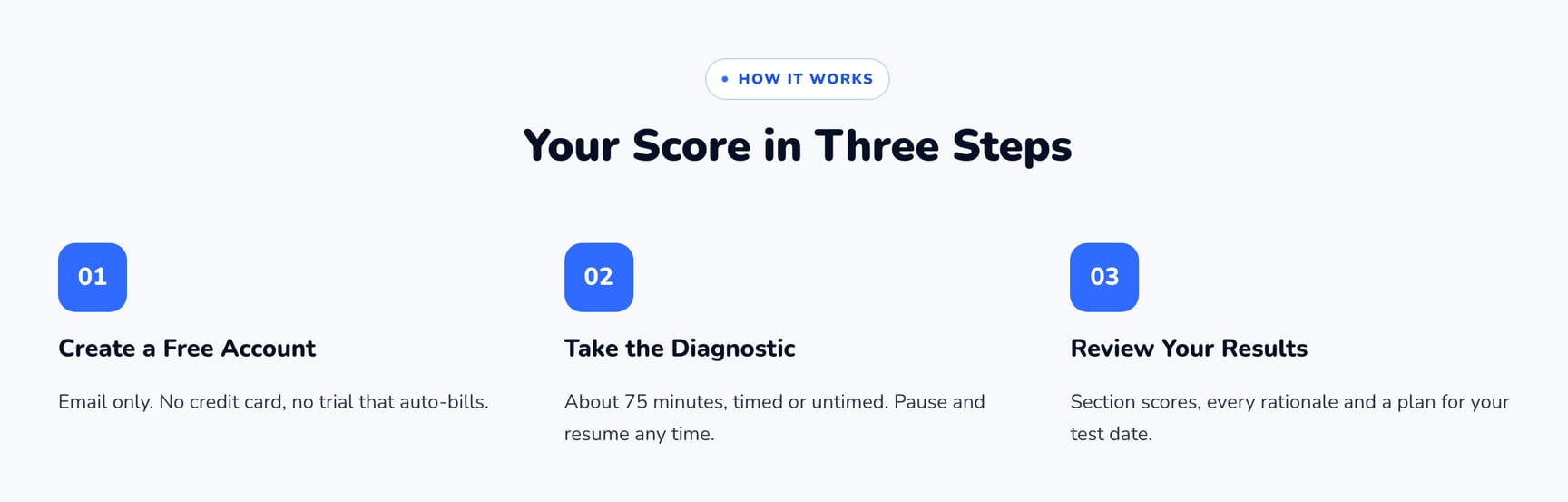
Three steps to a score report with our free TEAS practice test. No credit card required.
A 30-day plan between attempts
Most waiting periods are about a month. Here's how to use it:
- Days 1–3: Review your score report. List the sub-topics where you scored lowest, such as anatomy and physiology, measurement and data, or conventions of standard English.
- Days 4–20: Study your weakest areas first. Spend most of your time on the two or three sub-topics costing you the most points. Our TEAS science practice questions and TEAS math practice pages are a good place to start.
- Days 21–27: Take timed practice exams. Practice at real pacing, about one minute per question in English and 72 seconds in Science, and review every explanation.
- Days 28–30: Light review and rest. Confirm your test appointment, ID, and testing requirements, and get a full night's sleep before the exam.
Common reasons scores don't improve
- Re-reading instead of practicing. Active practice with explanations builds recall; re-reading notes mostly builds familiarity.
- Studying strengths. It feels productive to review what you know, but points come from your weakest sub-topics.
- Ignoring timing. Many students know the material but run out of time in Math and Science.
- Testing too soon. If your practice scores aren't consistently above your target, wait for the next available date.
Getting structured help
If you've already taken the TEAS once, a structured course can help you use the waiting period well. Every TEAS Experts plan includes the full question bank, all four sections, and full-length timed exams:
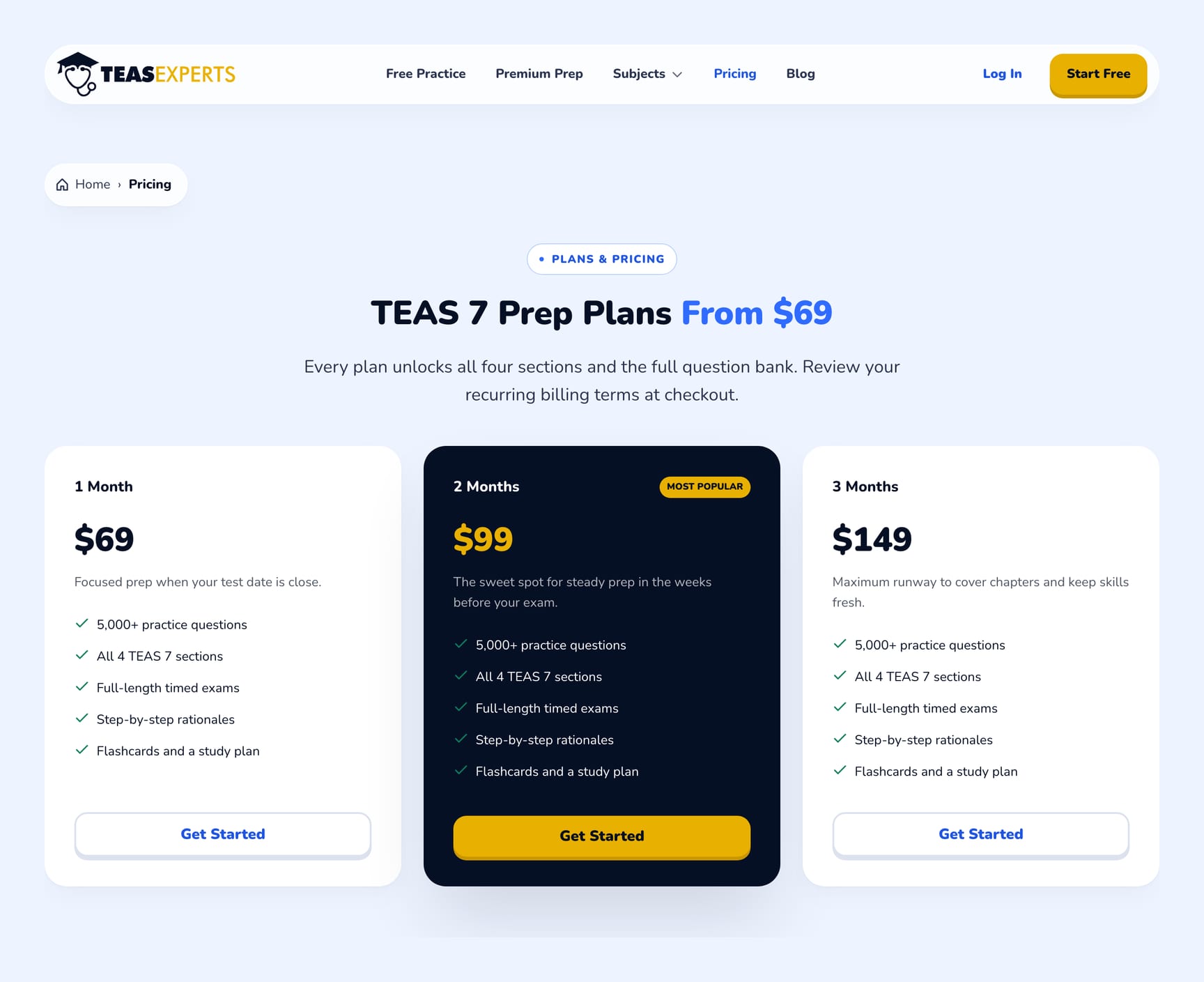
TEAS 7 prep plans. See current pricing.
Frequently asked questions
Is there a limit on how many times you can take the TEAS?
ATI doesn't publish a universal lifetime limit, but most nursing programs limit attempts, commonly to two or three per year or per application cycle.
How long do you have to wait to retake the TEAS?
Waiting periods are set by schools and testing sites. Published examples range from about 7 days to 30 days, and 30 days is common.
Does failing the TEAS look bad?
A single low attempt followed by a strong one usually matters less than your best or most recent score, depending on the program's policy. Repeated low attempts can hurt, so prepare properly before each one.
Can I retake just one section of the TEAS?
Generally no. The TEAS is taken as a full exam, even if only one section needs improving.
Can I take the TEAS online for a retake?
Some programs accept remote attempts through ATI and some don't, and remote attempts may count toward the same attempt limit. Check with your program before booking.
Make your next attempt your last
Every attempt costs money and uses up one of your limited chances. Before you schedule, take our free TEAS practice test to see whether you're ready. If you need a structured plan, the TEAS Experts prep course gives you practice questions for every section, full-length timed exams, and explanations for every answer.
