
TEAS vs HESI A2: Key Differences, Difficulty & Which Exam You Need

The TEAS and the HESI A2 are both nursing school entrance exams, but they're built differently. The ATI TEAS 7 is a fixed exam: every test taker gets the same four sections (Reading, Math, Science, and English) in 209 minutes. The HESI A2, made by Elsevier, is modular: each school chooses which sections its applicants take. Which one you take usually isn't your choice. It depends on what your nursing program requires.
This guide compares the two exams on content, length, scoring, difficulty, and preparation, and explains how to plan if you're applying to programs that use different exams.
Key takeaways
- Take the exam your program requires. Most programs accept only one.
- The TEAS is the same for every applicant; the HESI A2 changes with the sections your school selects.
- TEAS Science blends four subjects into one section, with anatomy and physiology carrying the most weight. HESI tests each science separately.
- Much of the preparation overlaps (math, reading, grammar, and anatomy and physiology), so studying for one helps with the other.
TEAS vs HESI A2 at a glance
ATI TEAS 7
- Made by: ATI (Assessment Technologies Institute)
- Structure: fixed. Every applicant takes the same four sections.
- Length: 170 questions (150 scored) in 209 minutes
- Sections: Reading (45 questions, 55 minutes), Math (38, 57), Science (50, 60), English and Language Usage (37, 37)
- Scoring: a composite percentage plus an ATI Academic Preparedness Level (Developmental, Basic, Proficient, Advanced, or Exemplary)
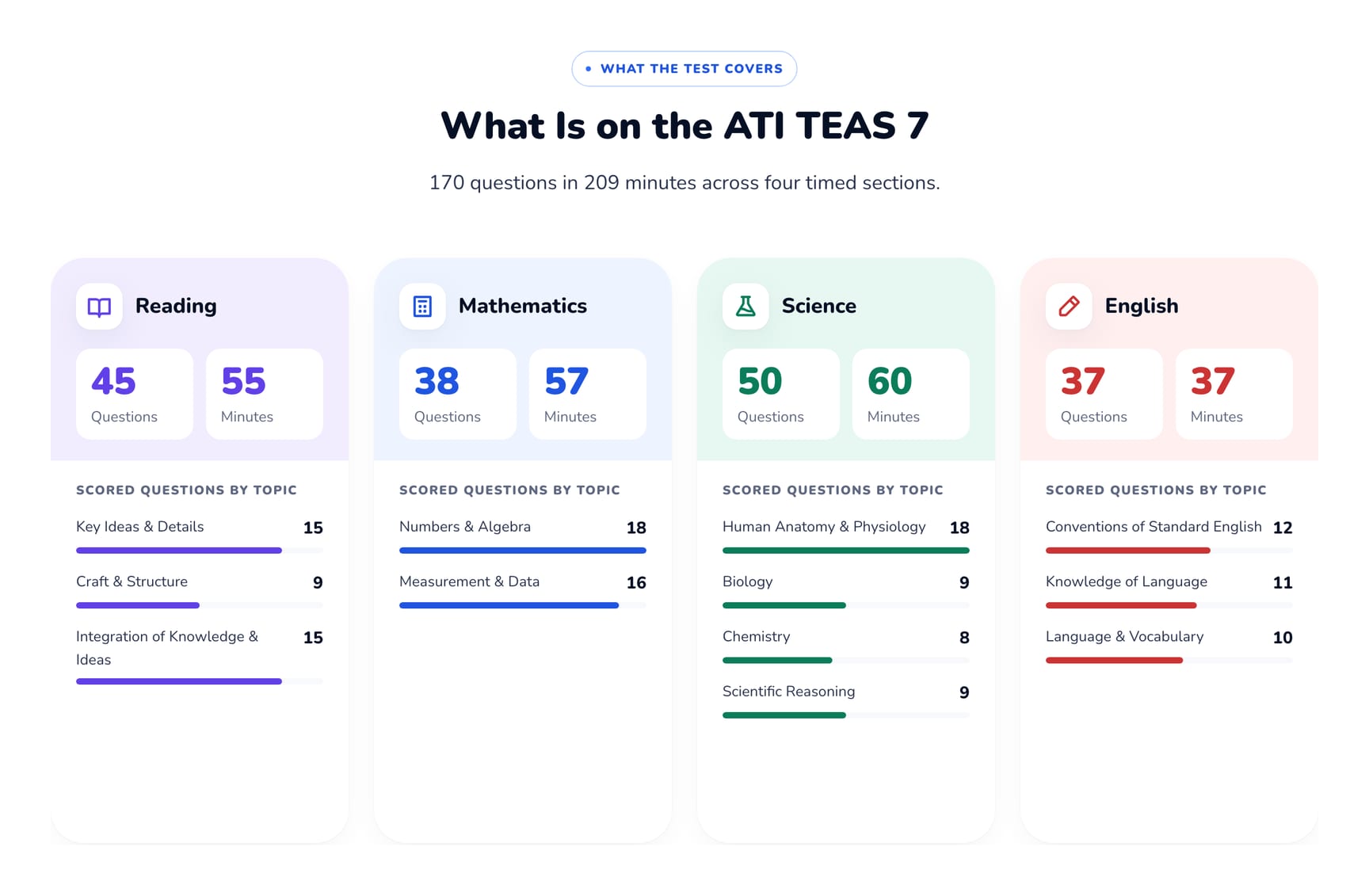
The four TEAS 7 sections and their scored topics. Source: our free TEAS practice test page.
HESI A2
- Made by: Elsevier (HESI stands for Health Education Systems, Inc.)
- Structure: modular. Each school chooses the sections.
- Possible sections: Math, Reading Comprehension, Vocabulary and General Knowledge, Grammar, Anatomy and Physiology, Biology, Chemistry, and Physics, plus an unscored learning style and personality profile at some schools
- Length: depends on the sections assigned. A full set of academic sections can take around four hours.
- Scoring: a percentage for each section plus a cumulative score. Many programs look for 75%–80% or higher.
The five biggest differences
1. Fixed vs. custom content
With the TEAS, you know exactly what's coming because the blueprint is the same for everyone. With the HESI A2, you need to ask your school which sections it requires. Many programs require the core academic sections (math, reading, vocabulary, grammar, and one or more sciences), but the combination varies from school to school, and sometimes between programs at the same school.
2. How science is tested
TEAS Science combines anatomy and physiology, biology, chemistry, and scientific reasoning in one 50-question section. Anatomy and physiology carries the most weight with 18 scored questions. On the HESI A2, each science is its own section, and schools may require only one or two of them. If your program requires HESI Chemistry or Physics, expect more depth in that subject than the TEAS asks for.
3. Vocabulary and grammar
The HESI A2 has a dedicated Vocabulary and General Knowledge section, often with health care terms. On the TEAS, vocabulary is folded into English and Language Usage alongside grammar, punctuation, and sentence structure, and the whole section allows only about one minute per question.
4. Scientific reasoning and data
The TEAS tests scientific reasoning directly: identifying variables, interpreting graphs, and evaluating experiments. TEAS Reading also includes charts, labels, and questions that compare multiple sources. The HESI A2 focuses more on subject knowledge within each section.
5. How scores are reported
The TEAS gives you one composite score and a preparedness level that schools compare directly. HESI A2 results are reported section by section, and programs may set minimums for individual sections as well as the cumulative score. See what counts as a good TEAS score for the TEAS score levels.
Which exam is harder?
Neither exam is objectively easier. It depends on your strengths and on which HESI sections your school requires.
- The TEAS may feel harder if you struggle with time pressure, data interpretation, or experiment-based questions, or if anatomy and physiology isn't your strong suit.
- The HESI A2 may feel harder if your program requires chemistry or physics, or if vocabulary isn't your strength.
- The TEAS is easier to plan for because its content never changes from one school to the next.
Which one should you take?
Take the exam your program requires. Before you start studying, check:
- Which exam each program on your list accepts. Some schools accept only one; a few accept either.
- For HESI: which sections are required, and whether there are section minimums.
- For TEAS: the minimum composite score and any section minimums.
- Retake rules and deadlines. Both exams have school-specific limits on attempts and waiting periods. Here's what to know about retaking the TEAS.
- Score validity. Programs often only accept scores from the last one or two years.
If your programs require different exams
Start with the exam whose application deadline comes first, and build your plan around the overlap. Study the shared content (math, reading, grammar, anatomy and physiology) first, then spend your final two to three weeks on the exam-specific sections: scientific reasoning and data questions for the TEAS, and any required chemistry, physics, or vocabulary sections for the HESI.
Preparing for both exams
The content overlaps a lot, so studying for one helps with the other:
- Math: fractions, decimals, percentages, ratios, unit conversions, and basic algebra appear on both.
- Reading: main ideas, supporting details, and inferences are tested on both.
- Grammar: parts of speech, punctuation, and sentence structure appear on both.
- Anatomy and physiology: heavily tested on the TEAS and a required section at many HESI schools.
The main extra work for the HESI A2 is any standalone chemistry, physics, or vocabulary section. The main extra work for the TEAS is scientific reasoning and reading questions based on charts and multiple sources.
A simple 6-week plan for the TEAS
- Week 1: take a diagnostic and list your three weakest sub-topics.
- Weeks 2–3: anatomy and physiology, then the rest of Science. Try our TEAS science practice questions.
- Week 4: Math, with an emphasis on conversions and word problems. See TEAS math practice.
- Week 5: Reading and English under timed conditions.
- Week 6: two full-length timed practice exams, with a full review of every miss.
Frequently asked questions
Is the TEAS or HESI A2 longer?
The TEAS is always 209 minutes of testing time. HESI A2 length depends on how many sections your school assigns; a full set of academic sections can run around four hours.
Can I take the TEAS instead of the HESI?
Only if your program accepts it. Schools choose their entrance exam, and most accept just one.
Do the TEAS and HESI A2 cost the same?
Fees are set by the testing site or school and vary by location and testing format. Check your program's testing page for current prices.
Is there physics on the TEAS?
No. TEAS Science covers anatomy and physiology, biology, chemistry, and scientific reasoning. Physics appears only on the HESI A2, and only if your school requires that section.
Which exam do more nursing schools use?
Both are widely used, and it varies by region and program. Check each school's admissions page rather than relying on general rules.
Preparing for the TEAS?
If your program requires the ATI TEAS 7, the fastest way to see where you stand is our free TEAS practice test, which gives you a score for each section. When you're ready for full preparation, the TEAS Experts prep course includes 5,000+ practice questions for every section, full-length timed exams, and step-by-step explanations.
